Mturk Jobs

Mturk Jobs
Mturk Jobs

Tank

Saturday, July 10, 2010

Hacking Infrared with PIC 16F84A


Send an Infrared signal with PIC 16F84 :

In this post, we 'll learn about transmission of the Infra red signals using PIC16F84. You can use Infra red signal in many projects ( Robots, Touch less counters, Theft alarming .. )

All you need to know to start using Infra Red signals are IR transmitters ( IR LEDs ) and IR receivers ( IR receiver modules ).


The IR LEDs are normal LEDs in the outer shape but they emit IR signals and of course these signals cannot be seen by the human eye. You can though make sure it is working fine by using a digital camera. The digital camera can detect the Infra Red signal and makes them visible to you.

This image shows you how the digital camera in the mobile phone can make you see the IR signal transmitted from a normal IR remote control.


The other difference between visible light LED and IR LED is that in visible light LED, the +ve terminal (Anode) is the longer one. But in IR LED, the +ve terminal (Anode) is the shorter one.


The second thing you need to know is the IR receiver module. It is an IR receiver component connected to a demodulator and amplifier circuit. The function of the demodulation circuit is to demodulate the modulated signal received by the receiver module. This means that this module can receive and understand ONLY modulated signals !!!

YES , that's true. And this is used to differentiate between the IR communication and control signals and IR signal emitted from all the objects around us and from all visible light sources. The demodulator circuit has a Band Pass Filter (BPF) that can detect only signals modulated by a 34kHz carrier signal. Here is a datasheet for TSOP312 Infrared receiver module .


 IR Module
This means that if you want to transmit a signal that can be demodulated as (1), you need to send a continuous signal of 34kHz from your IR transmitter LED.


This is the signal I captured from the Remote Control by the IR receiver


And this is the signal I generated from the PIC 16F84A


The software is very simple this time and written in Assembly Language . All it does it sending pulses to the IR LED at the correct frequency for the correct periods of time. It consists of a 34KHz carrier modulated by the signal of consecutive zeros and ones.


I knew the time coding of the TV remote control by capturing the signal using the IR receiver module to the sound card of the PC . Then I viewed it using a sound editing software to show the exact times for the IR signal.


Here is the link for the Proteus 7 model and software for the project.


Project on instructables:

https://www.instructables.com/id/Capturing-and-Generating-Infra-Red-Signals-With-PI


If you like this blog you can support us by many ways:
   
   1. Leave comments stating your point of view about this article.

   2. Buy our book on Amazon Learn By Making.

   3. Click on links of our sponsors without adding any extra cost on you if you make purchase from them. Actually, many of these offers are totally free.
  4. Visit our new website outatime.tech.

Thank you for visiting our blog.

Monday, June 7, 2010

Seven Segment POV. Microchip PIC 16F84 Seven segment Persistence of Vision Effect

This is a post about the POV ( Persistence of Vision ) Display that uses one 7 Segment display.

In short, I made this little project as a proof of concept of something I 've always noticed in many electronic devices those used 7 segment display.


In those devices, the 7 segment display was flickering instead of lighting it with steady volt and displaying the number accordingly. That flickering effect may be nice to some people and may be annoying for others.

So I decided to build this project so fast on a breadboard and wrote the C code for it.

In this image you can see the 7 segment connected to the PIC16F84A Microcontroller on a breadboard and flickering with numbers.


I just made this 7 segment display flickers with different numbers


I thought that if those flickering devices displayed many numbers at high speed and have been moved , guess what , the POV effect will be produced.

That's right. the same POV effect we 've seen made using LEDs can be produced by a single moving 7 segment display.

Here, you can see some pictures of the breadboard while being waved to the left and right in front of the camera.


The POV effect here makes our eyes ( and the camera too ) see the numbers as separate from there each other as four digits.


Here is a short video.


The circuit is very simple. I used a common anode 7 segment display directly driven by the PIC16F84A. And written the program in C code. The 7 segment patterns are directly sent to PORTB to be displayed on the 7 segment display.


You can find the Proteus 7 model and C program here .


I hope you enjoy this project.


If you like this blog you can support us by many ways:
   
   1. Leave comments stating your point of view about this article.

   2. Buy our book on Amazon Learn By Making.

   3. Click on links of our sponsors without adding any extra cost on you if you make purchase from them. Actually, many of these offers are totally free.
  4. Visit our new website outatime.tech.

Thank you for visiting our blog.


Saturday, May 8, 2010

I love PIC 16F84 :LCD to PIC 16F84 Interface

LCD Interface to PIC 16F84

I really love this Microcontroller PIC 16F84 . I am always searching for programs and projects and piece of code written for this old Microcontroller.

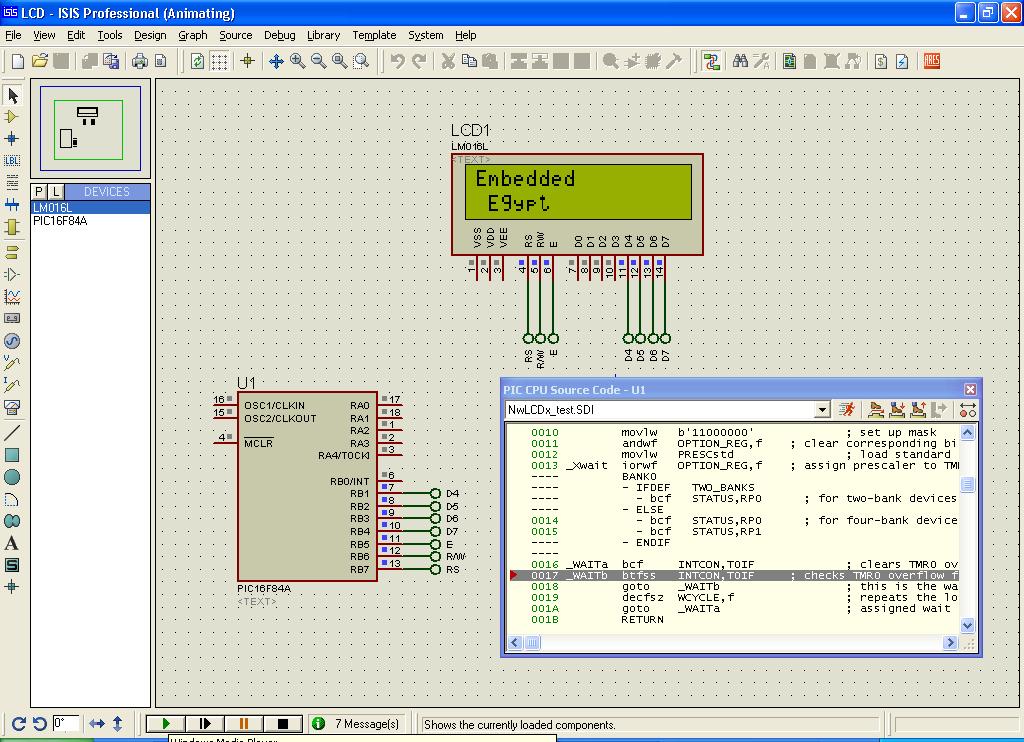
Today I found code on the web for this chip interfacing it to a standard LCD module.

http://www.electronic-engineering.ch/microchip/projects/LCDx_test/LCDx_test.html#assembler_code


It is written in assembly language and I am not going to explain it. So I 'll leave it to you to understand.


I only made a Proteus 7 model for the circuit that you can find it here . I promise you to make a new post for the LCD interface using the embedded C language.


If you like this blog you can support us by many ways:
   
   1. Leave comments stating your point of view about this article.

   2. Buy our book on Amazon Learn By Making.

   3. Click on links of our sponsors without adding any extra cost on you if you make purchase from them. Actually, many of these offers are totally free.
This means that you can enjoy something for free and still support our blog to keep posting useful stuff.


Amazon.com - Read eBooks using the FREE Kindle Reading App on Most Devices


This is the well-know Amazon Kindle platform. If you sign up for the free reader from Amazon to read any book, we get commission. 
There are many useful book for free on Amazon Kindle. Even you can find best sellers offered for free on Kindle format.
The best part is you can have the application on any platform. You can even read any book without installing any application by using Amazon Cloud-Reader on your browser.


Join Amazon Kindle Unlimited 30-Day Free Trial

You can join Amazon Kindle for 30 days free to have access to many paid book for free. You can cancel you subscription anytime.


Try Amazon Prime 30-Day Free Trial


The Amazon Prime is a special paid service from Amazon that offers good promotions and one-day free shipment for Amazon Shoppers. You can try this service for 30 days. You can cancel you subscription anytime.

Shop Amazon - Give the Gift of Amazon Prime


Try Audible and Get Two Free Audiobooks


Audible is the audio books website from Amazon. Many Kindle books are sold on Audible. You can try this service for free and get 2 free book. You can cancel you subscription anytime.


Shop Amazon - Create an Amazon Baby Registry

If you have a new baby borne or expecting one, you can create your free baby registry to easily save products and get offers and promotions on baby requirements.

  4. Visit our new website outatime.tech.

Thank you for visiting our blog.

Thursday, April 29, 2010

Microcontroller and Success : A true Story


At the year of 2008 , I found an advertisement in Appliance magazine about a free kit from a Microcontroller company called Renesas.

I really wanted to get this development kit. It was dedicated to motor control. I registered for this kit but unfortunately it was available only in USA and Canada.

However, my email was added in the company's clients database. Next, the company started a design contest at the same year called Renesas HTS Design Contest 2008.


The company invited me to participate in this design contest. It was a world wide contest which included shipment of free development kit to each eligible participant.

First I was admired by the idea itself of receiving a free development kit for the contest. I wanted to have this kit to learn more about Embedded C programming and to learn the Renesas technology which was new to me until that time.


To be eligible to receive the kit, there was a short demo for the company's other educational boards over a Virtual Lab environment. Then you are asked few questions to qualify for receiving the kit.

I passed through the stages of qualification and waited to receive the kit. When I received it I started to develop my design right away.


The company made a very good idea for improving the challenge through the launch of a forum for the challenge.

Each participant posted the idea of his entry and provided some technical details about it . This idea was very helpful and motivational. Any visitor or another participant can see your posted details and get admired with it or comment on it.


My design was a Multichannel Oscilloscope. The idea was very simple. I made the analog signals read by the analog-to-digital converter of the Microcontroller M16C ( on which the board is based )


The M16C has many A/D inputs but and there were 3 of them available in the challenge board.
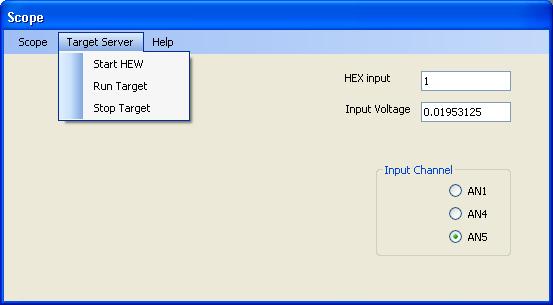
The signals values were converted into digital in the Microcontroller and they were sent to a PC based client software which incorporated the display of a virtual Multichannel Oscilloscope.


Virtual Oscilloscope


This is the Renesas HEW program window

From the PC based client, the user can choose the input channel to be displayed on the virtual oscilloscope and the rate at which it is displayed.


Program Control Panel

Before the last day of the deadline of the contest I submitted the source code for the Microcontroller side (written in Embedded C ) and the source code of the PC client (written in Visual Basic.Net) .

The results of the contest were announced on Renesas DevCon 2008.

I've got the 4th honorable mention prize for my entry "Multichannel Oscilloscope".


This contest was very challenging and rewarding. Thanks to Renesas who has helped me through all this contest.


Location for the HTS 2008 projects:

http://renesasrulz.com/design_contest_archives/renesas_2008_hew_target_server_design_contest/m/mediagallery/276.aspx

Here is the location for my project:

http://www.renesasrulz.com/docs/DOC-1290


رابط المقالة باللغة العربية
The link to the post in Arabic

http://arabic-embedded-egypt.blogspot.com.eg/2010/04/renesas.html


If you like this blog you can support us by many ways:
   
   1. Leave comments stating your point of view about this article.

   2. Buy our book on Amazon Learn By Making.

   3. Click on links of our sponsors without adding any extra cost on you if you make purchase from them. Actually, many of these offers are totally free.
  4. Visit our new website outatime.tech.

Thank you for visiting our blog.

Saturday, April 17, 2010

Information Disaster Recovery .

Data Recovery In Egypt

This post is not about Embedded Systems. It is about a problem that many people face it. Many people save their valuable data on their PCs and then something happens. A virus infects the MBR( Master Boot Record ) of the hard disk and all the partitions and data on that PC is not accessible. Or somebody saves his data on partitions other than the system partition but tries to setup Windows on the system partition and makes a mistake and installs Windows on the data partition. When he finds this out, He tries to get his important and valuable data but he can't.


I've seen the two examples happening to many people. When your PC contains some games or songs or some sources for some common programs , then your loss wouldn't be great.


But what if these data were collected and produced over a long period of time ?

And what if these data were precious photos and memories that you cannot get from any where and you didn't make backup for them ?

And what if you have saved your Master or PHD data on this PC without making backup ?

Fortunately, you can recover the data form your hard or flash disk even if they were formatted by mistake or their MBR is corrupted due to a Virus infection or a wrong operating system installation procedure.

Many programs can help you to get you lost data.


I myself have done this many times. Both recovering data form a hard disk which the user has installed Windows on the data partition by mistake and recovered data form a Hard Disk with a totally corrupted MBR .

If you faced this problem some day and don't know where to start from, just give me a call. I am sure I can help.


If you like this blog you can support us by many ways:
   
   1. Leave comments stating your point of view about this article.

   2. Buy our book on Amazon Learn By Making.

   3. Click on links of our sponsors without adding any extra cost on you if you make purchase from them. Actually, many of these offers are totally free.
  4. Visit our new website outatime.tech.

Thank you for visiting our blog.

Thursday, March 11, 2010

Embedded Systems Committee

Well , this is not a technical post. I wanted to share this with all my friends in Egypt . Embedded Systems Committee is a group of Egyptian Embedded Systems Engineers who graduated from ITI intake 27 . They wanted to do something useful to there community . They wanted to share there knowledge with their colleges and Engineering students through this group.


I found about this group and their activities in Egypt on EED '09 , and since then I 've been trying to find their contacts .

Now, I will share this information with you to contact them and you may attend one of their seminars .


This is their group on Facebook

http://www.facebook.com/group.php?gid=18263984084


And this is their Email address :

info@ESCommittee.com


Website :
www.ESCommittee.com


And this is a group I created on Facebook just after I heard about them in EED '09 before I find theirs .

http://www.facebook.com/group.php?v=info&gid=113460832366#!/group.php?v=wall&gid=113460832366


Finally, I hope you found this post useful.


If you like this blog you can support us by many ways:
   
   1. Leave comments stating your point of view about this article.

   2. Buy our book on Amazon Learn By Making.

   3. Click on links of our sponsors without adding any extra cost on you if you make purchase from them. Actually, many of these offers are totally free.
  4. Visit our new website outatime.tech.

Thank you for visiting our blog.

Tank